
 The ability to quantify energy consumption is essential for your plant and your team. Power consumption monitoring of your installation provides you with the data needed to make important energy management decisions.
Why monitor power consumption with a Power Logger?
- Understanding the capacity of your existing electrical distributor
- Troubleshooting circuit breaker tripping problems
- Identifying energy costs
- Tracking energy waste
1. Installation safety
Electricians often have to perform a load analysis before new loads can be added to an existing panel. Why? These requirements are set by the electrical inspector, the electrical engineer who designed the project or the customer adding the new loads. The purpose is to determine whether there is sufficient capacity to add new loads.
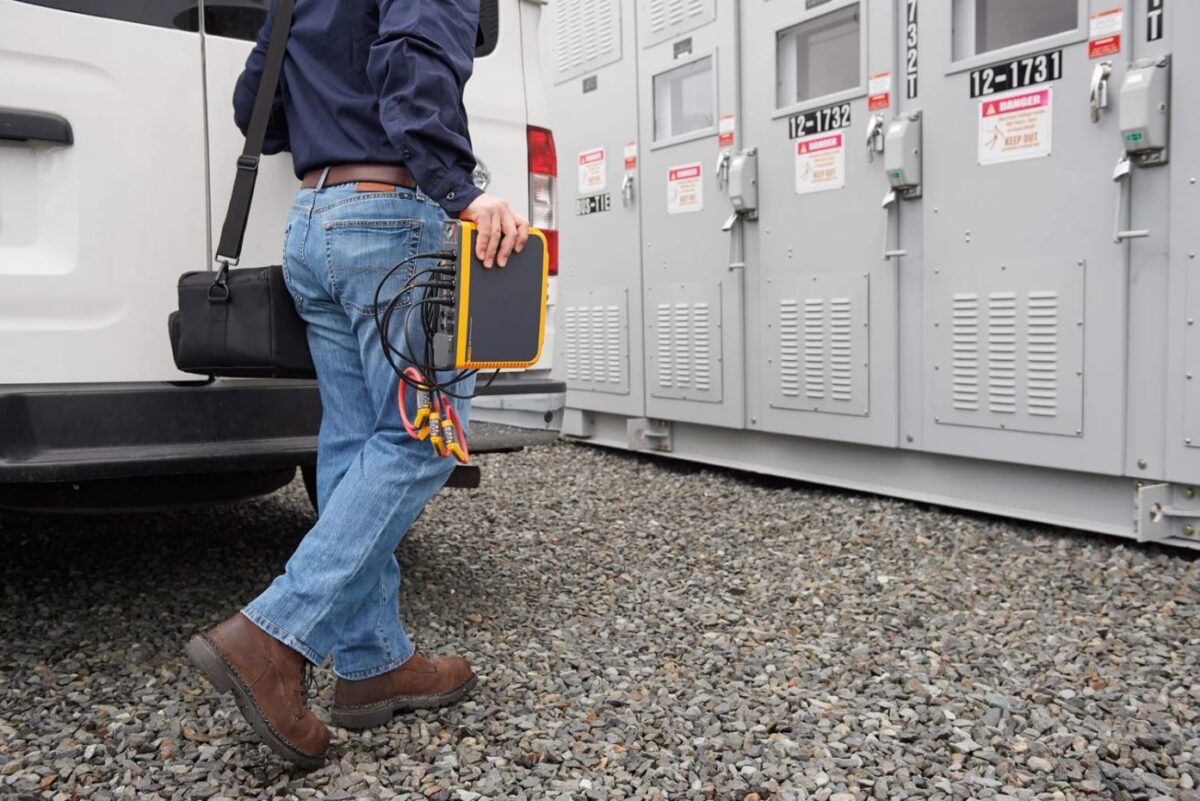
In a load analysis, a power logger used to document existing load levels (three-phase power dissipation) over long periods of time. And this is where safety comes into play. On the one hand, load analysis can be used to ensure compliance with local safety regulations. On the other hand, failure to conduct a load analysis before adding new loads may result in the overloading of an existing electrical source or the creation of unsafe and unreliable electrical situations.
2. Managing energy costs and realising savings opportunities
Energy costs are a large part of total operational costs, and yet many companies do not have a good overview of where their energy money is going. They only get an overall monthly bill, with no indication of whether that consumption is normal or excessive for that month's operations.
By logging energy consumption at the main service input and then at large loads and secondary feeds, facilities can gain insight into how much energy is consumed when, by what and at what hourly rate. The data will actually always show energy wastage that can be corrected by changes in operations. For example, consider switching off certain loads, reducing loads during periods of high tariffs, or adjusting the schedule so that loads are operational during periods of off-peak tariffs.
3. Electricity bill accuracy
Owners of large and medium-sized facilities often install submeters so they can bill tenants for their specific electricity consumption. However, these submeters are usually installed incorrectly, resulting in unreliable data. Installation problems range from power inverters placed incorrectly and power inverters on the wrong phase, to errors in submeter configuration.
A good practice is to check the measured value with a portable energy logger. The logger data provides an order-of-magnitude comparison of what is charged with what is consumed. A significant difference between the energy consumption charged and the logger data indicates that the submeter setting should be investigated.
4. Rebates and financial incentives
Utilities offer premiums and rebates to encourage their customers to reduce their energy consumption. The aim is to serve more customers with the same current energy supply, as building new power plants is not an option. Many premiums and rebates are aimed at retrofitting existing buildings, with energy-efficient lighting and high-efficiency motors, for example, or replacing motor starters with frequency-controlled drives.
To grant the financial incentive bonus, the utility first requires proof of energy savings - and for this, a load analysis is ideal. A load analysis performed before a retrofit identifies the current energy consumption for reference, a load analysis after a retrofit confirms the energy savings achieved by the retrofit.
5. Detecting problems with mains power quality
Often, the only way to solve a problem is to record and analyse data over a long period of time. For these more complex problems, energy loggers are invaluable, and they are much more affordable and easier to use than a complicated Power Analyzer.
A good example is when a circuit breaker trips randomly. Obvious situations, such as a heavy motor starting, are not always the cause. In reality, the cause of the tripping may be something that does not seem obvious, or may only occur when technicians are not present to notice it (e.g. at night). Having a maintenance technician monitor the load until the circuit breaker trips is impractical. Connecting an energy logger to the load side of the circuit breaker to record the current draw for an extended period of time can then help to solve the problem.