
 It has been proven that a well-built digital multimeter under demanding conditions performs better than a second-line model. Not only is a top-of-the-range instrument more resistant to your working environment, but it also helps keep you safe. Once you have a multimeter, safe use of digital multimeters is still important in any environment you work in. Always check that your multimeter is safe to use.
What are electrical parameters?
Every piece of equipment that uses or moves electricity has a set of electrical parameters. These are classifications and codes, such as CAT specifications and protection classes (IP codes), which are aligned with standards set by specially appointed teams of professionals. Understanding the electrical parameters of a device will help you better understand how to test its performance and how to keep it and yourself (and those around you) safe. Some examples of electrical parameters are impedance, inrush current, power factor and voltage drop.
What are the CAT specifications of the multimeter?
Digital multimeters are suitable for different electrical parameters, so you should check for proper CAT specifications, IP codes and independent verification symbols to ensure that the meter you select has been tested by an independent laboratory and is safe for your measurements.
When determining the correct overvoltage category (CAT II, CAT III or CAT IV) of the installation, you should always select an instrument that is suitable for the highest category in which you can potentially use the instrument and select a voltage standard that is suitable for or exceeds these situations. Meters with a CAT specification are designed to minimise the risk of an arc in the meter. Ratings are usually located near the inputs.
To give an example: if you are preparing to measure a 480-V power distribution panel, you should use a meter that is at least CAT III-600 V compliant. This means that a CAT III-1000 V or CAT IV-600 V may also be suitable in this situation.
| Measurement category | Description | Examples |
| CAT IV | Three-phase when connected to mains, all conductors outside
Limited only by the mains transformer feeding the circuit 50 kA short-circuit current |
|
| CAT III | Three-phase distribution, including single-phase commercial lighting
'50 kA short-circuit current |
|
| CAT II | Loads connected to a single-phase connection.
'10 kA short-circuit current. |
|
The two-digit IP code indicates your meter's resistance to dust and water. It describes the size of dust particles that are retained and to what depth your multimeter can be submerged while continuing to function.
Degree of protection against ingress of solids
| Level | Object size | Effective against |
|---|---|---|
| 0 | Object size | No protection |
| 1 | >50 mm | A large area of the body |
| 2 | <12.5 mm | Fingers and the like |
| 3 | <2.5 mm | Tools, thick cables |
| 4 | <1 mm | Granular objects. Most cables, screws, etc. |
| 5 | Protected against dust | Not fully protected, but should not hinder proper operation |
| 6 | Dustproof | No penetration of dust. Dustproof |
The second digit of an IP rating indicates the level of protection against water.
Degree of protection against water ingress
| Level | Protected against | Details |
|---|---|---|
| 0 | Not protected | |
| 1 | Dripping water | Vertical falling water. No harmful effect |
| 2 | Dripping water, 15° tilt | Vertical falling water. No harmful effect when the device is tilted up to 15° from its normal position |
| 3 | Spray water | Water drops as spray at up to 60°. No harmful effect |
| 4 | Splashing water | Water splashing from any direction. No harmful effect |
| 5 | Water jets | Water sprayed through a nozzle from any direction. No harmful effect |
| 6 | Powerful water jets | Water projected in powerful jets through a nozzle from any direction. No harmful effect |
| 7 | Immersion up to 1m | Immersion in water up to 1 m for 30 minutes. Waterproof up to 1 m for 30 minutes |
| 8 | Immersion deeper than 1m | Continuous immersion |
At Fluke, we test our products for safety so that they go to the limit. Only when the test team is no longer able to interfere with the instrument's operation can the instrument be released for production. The goal is to ensure that a Fluke digital multimeter can withstand the most demanding real-world conditions time and time again. And that you, the user, remain safe and can return home every day. We also ensure that our products are independently tested to back up our claims.
What are security measures for multimeters?
Safe use of digital multimeters is important. Before taking a measurement with your multimeter, inspect it visually. Check the meter, measurement probes and accessories for signs of physical damage. Make sure that all plugs are tightened securely and look for exposed metal or cracks in the housing. Never use a damaged meter or damaged measuring probes.
After the visual inspection is done, check if your multimeter is working properly. Never just assume it is. Use a known voltage source or a monitoring device, such as the Fluke PRV240, to check that your meter is working properly. This is a requirement of NFPA70E (US) and GS38 (Europe).
Working with electricity always involves risk. Know what these hazards are and take appropriate precautions before you start taking measurements. Be aware of the possibility of spikes such as momentary overvoltages and arcing or sparking.
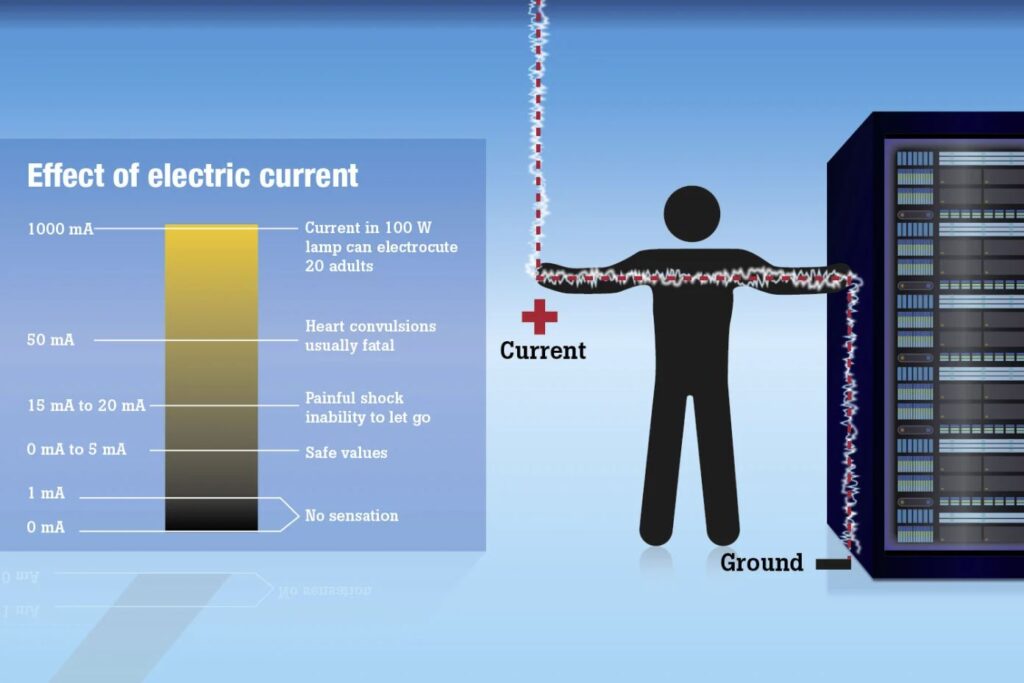
- Always assume that any electrical component in a circuit is live until you have taken the steps to positively discharge it. Shock occurs when the human body becomes part of an electrical circuit. So pay attention to the position of your body when working in electrical environments.
- Make sure you use the right personal protective equipment (PPE) in every situation. This means both on the body (i.e. gloves, headgear) and near the body (i.e. insulated rubber mats). These are required when working on or near live and exposed electrical circuits of more than 50V.
- Never work alone on or near exposed and live equipment. Stay safe and make sure you and your partner are also aware of the surroundings. If possible, do not perform measurements in damp or wet environments and make sure there are no atmospheric hazards nearby (i.e. combustible dust or vapour).
- Finally, keep an eye on the display of your digital multimeter for any visual warnings. It can alert users to irregularities such as unsafe voltages (30 V or higher) at the measurement probes.