
A true-RMS-device (RMS = Root Mean Square) is one of three instruments used to calculate alternating current (AC) or AC voltage:
- True-RMS digital multimeter (or clamp meter)
- Medium-response true-RMS digital multimeter (or clamp meter)
- Oscilloscope
Only the first two instruments are commonly used and both can measure accurate standard (pure AC) sinusoidal waveforms.
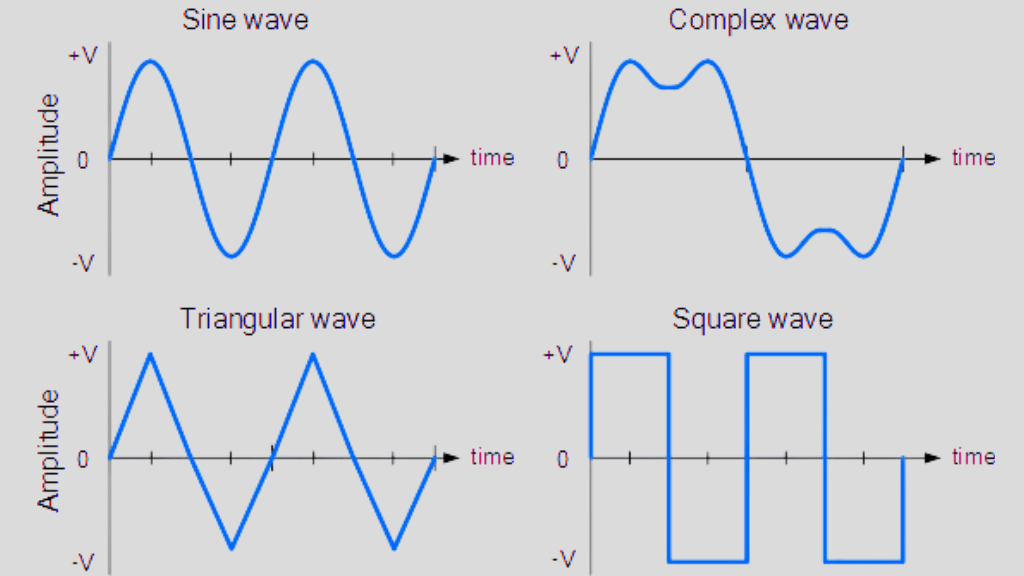
This does not alter the fact that a true-RMS meter is widely preferred because only it can measure both sinusoidal and non-sinusoidal AC waveforms. (See the illustrations at the top of the page.)
- Sinusoidal (sine) waves: Clean, without distortion, with symmetrical transitions between peaks and troughs.
- Non-sinusoidal waves: Waves with distorted, irregular pattern ejections, pulse trains, squares, triangles, sawtooth shapes and other ragged or angular shapes.
Calculate RMS
As mentioned earlier, RMS for Root Mean Square. Although understanding this formula can be challenging, RMS basically calculates the equivalent direct current value of an AC waveform. In more technical terms, it determines the ‘effective’ or DC heating value of any AC waveform.
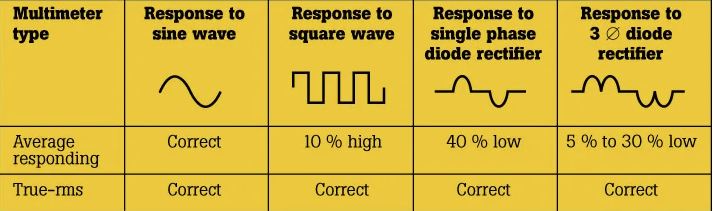
A meter for average values uses mathematical formulas to average for accurate measurement of pure sine waves. It can measure non-sinusoidal waves, but with uncertain accuracy.
One more advanced true-RMS meter can accurately measure pure waves and the more complex non-sinusoidal waves. Waveforms can be distorted by non-linear loads, such as frequency-controlled drives or computers. If an attempt is made to measure distorted waves with an averaging meter, the meter's calculations may be up to 40% too low or 10% too high.
Where to measure true-RMS
The need for true-RMS meters has increased as non-sinusoidal waves have become increasingly common in circuits in recent years. Some examples:
- Frequency-controlled motor drives
- Electronic ballasts
- Computers
- HVAC
- Semiconductor environments
In these environments, current is present in short pulses instead of the smooth sine waves drawn by a standard induction motor. The waveform of the current can have a great effect on the readout of current clamps. In addition, a true-RMS meter is a better choice for making measurements on electrical lines where AC characteristics are not known.
Reference: Digital Multimeter Principles by Glen A. Mazur, American Technical Publishers.