

What is a diode?
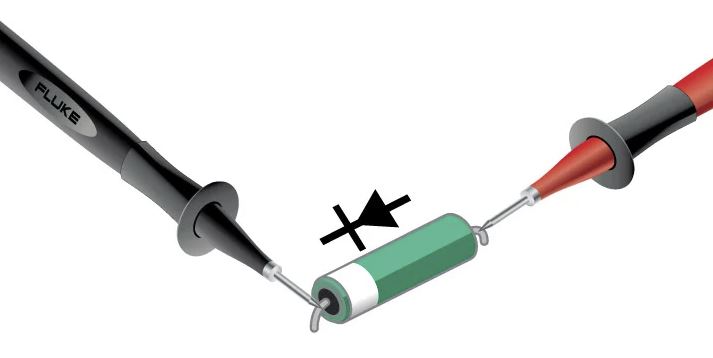
A diode is a semiconductor component that forms a kind of one-way switch for current. It allows current to flow easily in one direction, but hardly at all in the opposite direction.
Diodes are also called rectifiers called diodes, because they convert alternating current (AC) into pulsating direct current (DC). Diodes are classified according to type, voltage and current capacity.
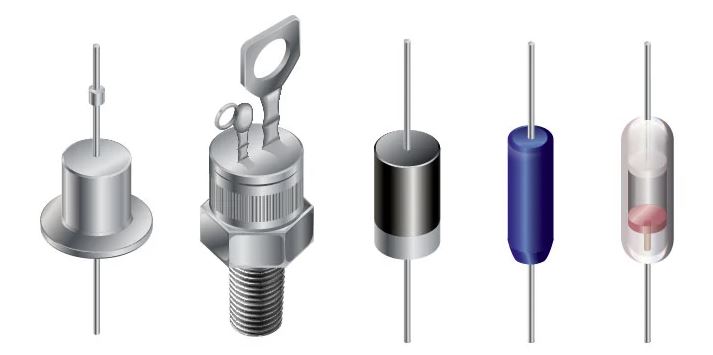
Diodes are polar: they have a anode (positive side) and a cathode (negative side). Most diodes allow current to flow only when positive voltage is applied to the anode. Different diode configurations are shown in this figure:
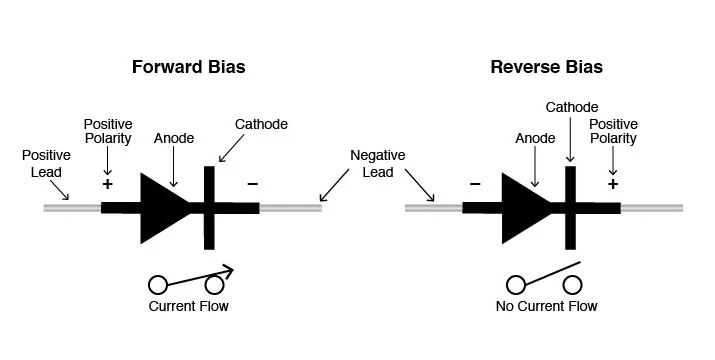
When a diode allows current passage, it is polarised in the forward direction. When a diode involves preload in the locking direction, it acts as an insulator and does not allow power passage.
Strange but true: The arrow of the diode symbol points in the opposite direction of electron emission. Reason: The symbol was devised by engineers and in their schematic representation, current flow proceeds from the positive (+) side of the voltage source to the negative (-). The same convention is applied for semiconductor symbols in which arrows are used: the arrow points in the ‘usual’ permitted direction of current flow, and against the permitted direction of electron flow.
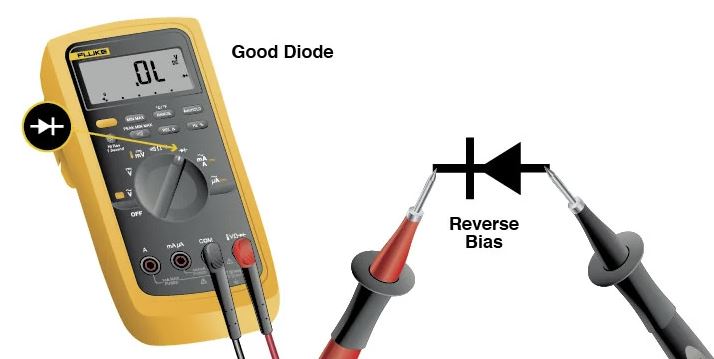
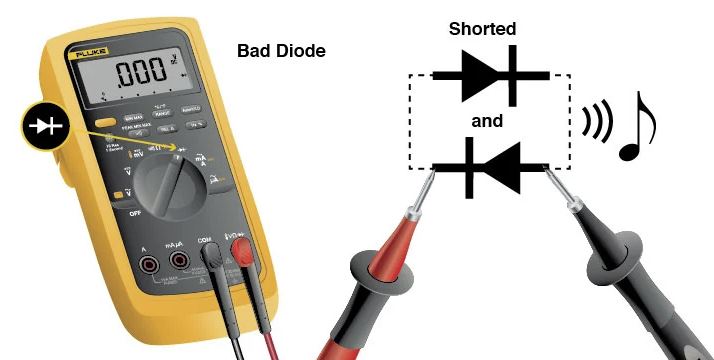
In a diode test of a digital multimeter, the diode produces a small voltage between the test wires, which is sufficiently strong to polarize a layer diode in the forward direction. The normal voltage drop is between 0.5 and 0.8 V. The resistance of a properly functioning diode in the forward direction is between 1000 ohms and 10 ohms if all goes well. When there is bias voltage in the reverse direction, the display of a digital multimeter the value OL is displayed (this indicates a very high resistance).
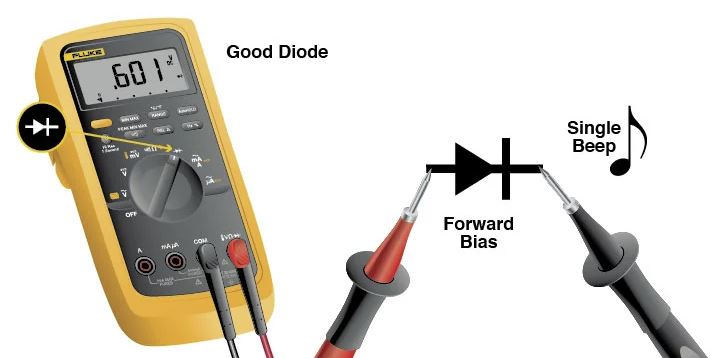
Diodes are rated for a specific current rating. If this is exceeded and the diode fails, a short circuit may occur and a) current may flow in both directions or b) current may be stopped in both directions.

Reference: Digital Multimeter Principles by Glen A. Mazur, American Technical Publishers.