
 For industrial plants, compressed air, gas and vacuum systems are an essential source of converted energy. Compressors are simpler than other sources of energy such as electricity and they are everywhere in today's factories. They power machines, tools, robots, lasers, product handling systems and much more.
Yet many compressed air, gas and vacuum systems suffer from wear and poor maintenance, contributing to the biggest waste of all: ever-present leaks. These leaks may be hidden behind machinery or located at connection points, in fixed overhead lines or in cracked pipes or worn hoses. The waste increases rapidly and can even lead to downtime.
Detecting and fixing leaks is not easy
Many factories and plants do not have a leak detection programme. Detecting and fixing compressed air, gas and vacuum leaks is not easy. Quantifying the amount of waste and determining the cost requires energy specialists or consultants who use energy analysers and loggers to monitor your air systems. By systematically calculating the annual cost savings from fixing leaks, they can make a strong business case for undertaking such a project.
Energy audits of compressed air systems are often carried out through partnerships of industry, government and non-governmental organisations (NGOs). One such partnership is the Compressed Air Challenge (CAC), a voluntary collaboration between these groups. Its sole purpose is to provide product-neutral information and educational materials to help industries generate and use compressed air with maximum sustainable efficiency.
The high cost of wasted air
According to the U.S. Department of Energy, a 1/8″ (3 mm) leak in a compressed air line can cost more than $2,500 a year. The Department of Energy estimates that an average US plant that is not properly maintained can waste 20% of its total compressed air production capacity due to compressed air, gas and vacuum leaks. The New Zealand government, as part of its Target Sustainability project, estimates that system leaks can account for 30 to 50% of a compressed air system's capacity. Rapid detection of compressed air, gas and vacuum leaks is a key factor in finding hidden profits. Air leaks can also lead to capital expenditure, rework, downtime or quality problems and higher maintenance costs.
To compensate for pressure loss due to leaks, business managers often tend to overcompensate by purchasing a larger compressor than necessary, which incurs significant capital costs and higher energy costs. System leaks can also lead to air equipment failure due to low system pressure. This can lead to production delays, unplanned downtime, quality problems, shorter lifespan and increased maintenance due to unnecessary switching compressors on and off.
For example, the maintenance manager of a manufacturer in the US says that low pressure in one of their air tools can lead to defects in their products. “Incorrect torque, either too low torque or too high torque, can result in recalls. This also leads to more man-hours in something that should be a very standard process,” he says. “It is throwing money down the drain through loss of profits and loss of products. At worst, demand may also be at risk because we could not deliver.”
It is no wonder that utilities, industry and government see compressed air systems as a potential source of cost savings. Compressed air, gas and vacuum leaks lead to waste. Fixing such leaks can save the company manager money and prevent the utility from having to build additional capacity into the system.
Why ultrasonic leak detection is inefficient
Unfortunately, the most common leak detection practices are rather primitive. An old-fashioned method is to listen for hissing sounds, which are almost impossible to hear in many environments, and spray soapy water on the area of the suspected leak, which is messy and could potentially be a slip hazard.
The current tool for detecting compressor leaks is a ultrasound detector, a portable electronic device that recognises high-frequency sounds related to air leaks. Typical ultrasonic detectors help find leaks, but their use is time-consuming and repair staff can usually only use them during scheduled downtime, while servicing other critical machinery may be a better use of time. These instruments also require the operator to be close to the equipment to find leaks, making the instruments difficult to use in hard-to-reach places such as ceilings or behind other equipment.
In addition to the time required to detect leaks with suds or ultrasonic detectors, there may be safety issues with these techniques related to finding leaks above or below equipment. Climbing ladders or crawling around equipment can be hazardous.
Pioneering for compressed air leak detection
What if there was a leak detection technology that could determine the exact location of a leak up to 50 metres away, in a noisy environment, without having to turn off equipment? Fluke has developed an industrial acoustic camera that does just that. Industrial maintenance managers call the Fluke ii900 Sonic Industrial Imager“Pioneering” for compressed air leak detection.
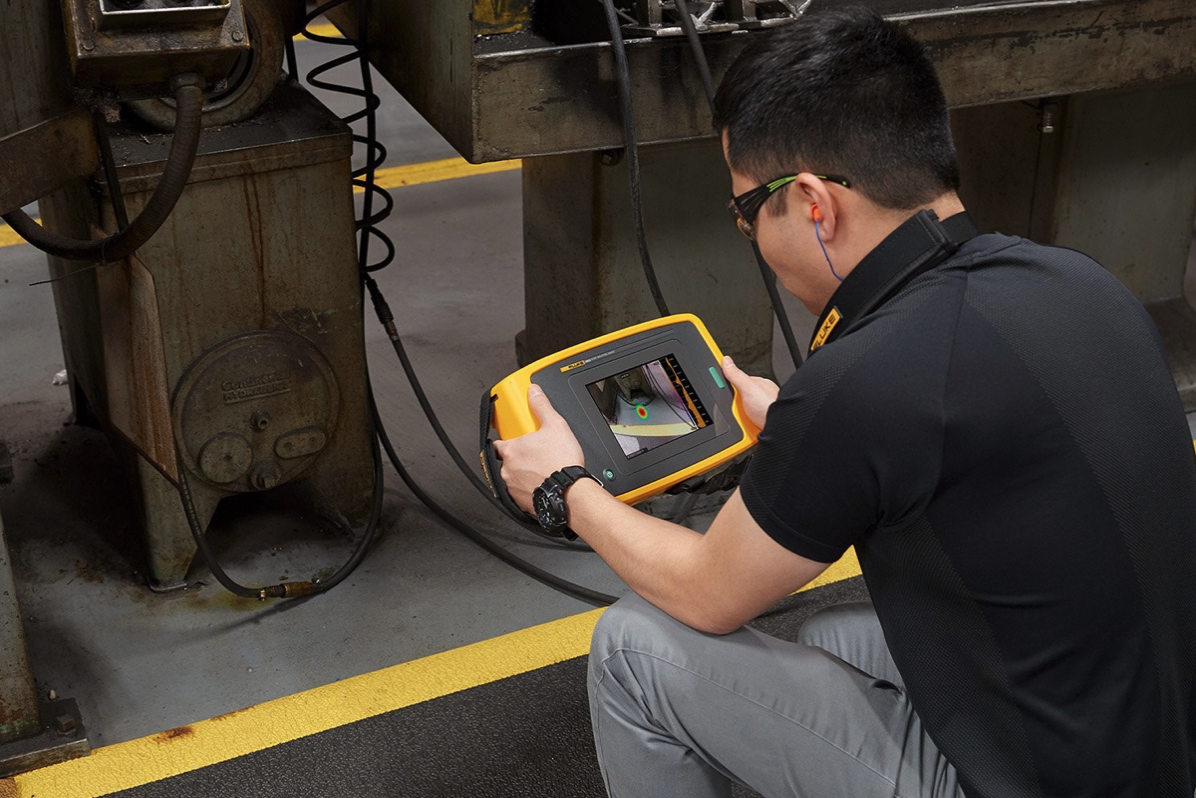
Capable of detecting a wider frequency range than traditional ultrasonic devices, this new acoustic industrial camera uses new SoundSight™ technology to provide enhanced visual scans of air leaks, just as thermal imaging cameras detect hotspots.
The ii900 features an acoustic array of small, super-sensitive microphones that detect both sonic and ultrasonic sound waves. The ii900 recognises a sound source at a potential leak location and then applies algorithms that interpret the sound as a leak. The results produce a SoundMap™ image, a colour map overlaid on top of the visible-light image, - showing exactly where the leak is. The results are displayed on the 7-inch LCD screen as a still image or real-time video. The ii900 can store up to 999 image files or 20 video files for documentation or compliance.
Large areas can be scanned quickly, detecting leaks much faster than other methods. Filtering can also be done by intensity and frequency ranges. A team at a large factory recently used two ii900 prototypes and detected 80 compressed air leaks in one day. The maintenance manager said that using traditional methods it would have taken weeks to find that number of leaks. By quickly detecting and fixing leaks, the crew also avoided potential downtime, which can cost an estimated $100,000 an hour in lost productivity at this plant.
Where to find leaks:
- Links
- Snakes
- Tubes
- Fittings
- Threaded pipe connections
- Shortcuts
- FRLs (combinations of filter, regulator and lubricator)
- Condensate traps
- Valves
- Flanges
- Gaskets
- Air supply boilers
How much air do you waste?
The first step in controlling leaks in compressed air, gas and vacuum systems is to estimate the leakage rate. Some leakage (less than 10%) is to be expected. Anything more is considered wastage. The first step is to determine your current leakage load so that you can use it as a benchmark against which to compare improvements.
The best method for estimating leakage load is based on your control system. If you have a system with start/stop control, simply start your compressor when there is no demand in the system - after working hours or shifts. Then measure a number of compressor cycles to determine the average time before the loaded system is unloaded. If there is no equipment in operation, the unloading of the system is due to leakage.
Leakage (%) = (T x 100) ÷ (T + t)T = load time (minutes), t = relief time (minutes)
To estimate the leakage load in systems with more complex control strategies, place a pressure gauge downstream of the volume (V, in cubic metres), including all secondary boilers, mains and pipes. If there is no demand in the system, except for leakage, bring the system to normal working pressure (P1, in psig). Select a second pressure (P2, about half the value of P1) and measure the time (T, in minutes) it takes the system to drop to P2.
Leakage (cfm free air) = [(V x ( P1 - P2) ÷ (T x 14.7)] x 1.25
The multiplier 1.25 corrects leakage to normal system pressure, taking into account lower leakage as system pressure decreases.
Efficiently fixing and repairing leaks can lead to significant cost savings for air-dependent businesses. Companies can not only save on energy consumption by repairing leaks, but can also improve production and extend the life of equipment.