
 The IEC 61000-4-30 Class A standard eliminates guesswork when choosing a power quality instrument.
Grid power quality logging, measurement and analysis is still a relatively new and rapidly developing field. Whereas fundamental electrical measurements such as RMS (effective voltage) and current have well-defined measurement parameters, many mains power quality parameters have no such definition. This fact has forced leading manufacturers to develop their own algorithms for measuring these mains power quality properties, resulting in hundreds of unique, global measurement methods.
With so much diversity between instruments, technicians often have to take the time to analyse and understand the capabilities and specific measurement algorithms of the instrument in question, rather than understanding the quality of the power supply itself. Standardising measurement methods allows direct comparison of results from different analysers.
Standard IEC 61000-4-30 Class A defines the measurement methods, collection times, accuracy and evaluation for each mains power quality parameter, to obtain reliable, repeatable and comparable results. In addition, the IEC 62586 standard defines the minimum set of parameters to be implemented for mains power quality instruments used in both portable and fixed installations.
As more manufacturers begin to design instruments for measuring and analysing mains power quality to Class A standards, technicians can be more confident in the measurements they take. All this increases accuracy, reliability, comparability and efficiency at work. The standard is updated periodically as the industry evolves and new measurement scenarios are discovered or required. Since its introduction in 2003, the standard has been updated several times and is currently in edition 3 (2015).
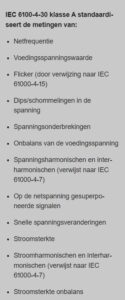 Examples of requirements according to class A
The measurement uncertainty of the supply voltage is set at 0.1% of the specified input voltage Udin over the range from 10% to 150% of Udin. It is important to note that in many cases accuracy is only specified at full scale, and while 0.1% accuracy is relatively easy to achieve, it is more difficult to achieve over this wide range.
In addition, the requirement states that measurements must be ‘continuous and non-overlapping’ over a 10/12 cycle for a 50/60 Hz electrical system. It is important to pay attention to this when looking at plant specifications, as units with a high degree of measurement uncertainty can lead to results that can be disputed by the utility or their customer.
Cheap mains power quality measurement systems, for example, often have higher levels of uncertainty when measuring at the lower end of the scale (example: measuring on a potential transformer with phase-to-neutral voltage at 58 volts). In addition, variations can also go unnoticed if measurements are not taken contiguously. These errors can lead to defective equipment being thought to be working properly when in fact it is not. With a Class A certified instrument, a technician can rest assured that measurements have been classified with internationally accepted uncertainty values. This is especially important when checking compliance with regulations or comparing results between different instruments or batches. Functional test and uncertainty requirements for Class A equipment are detailed in IEC 62586-2.
Voltage fluctuations and interruptions should be measured on a full cycle and should be updated every half cycle so that the instrument can combine the high resolution of data points sampled on a half cycle with the accuracy of RMS calculations on a full cycle. Relying solely on full-cycle calculations could misidentify valid conditions, while using only half-cycle calculations may not provide the required accuracy to fully understand any problems.
Collection periods are measurement data compressed by a mains power quality instrument at specified intervals. A Class A instrument shall display data in the following collection periods:
- The standard time interval of measurement should be a 10/12 cycle (~200 msec) at 50/60 Hz. The interval time varies depending on the actual frequency.
- 150/180 cycles (~3 sec) at 50/60 Hz. The interval time varies depending on the actual frequency.
- Interval of 10 minutes synchronised with coordinated universal time (UTC)
- Interval of 2 hours for Plt flicker
External time synchronisation is required to obtain accurate timestamps, allowing accurate correlation of data between different instruments. Accuracy is specified at ± 20 ms for 50Hz instruments and ± 16.7 ms for 60Hz instruments, regardless of the total time interval. Achieving this accuracy requires either a GPS clock via a GPS receiver or NTP (Network Time Protocol) via Ethernet. When synchronisation per an external signal is no longer available, the timing tolerance should be better than ± 1 s per 24-hour period. However, this wider tolerance is not confirmation that the measurements are Class A compliant. The lack of accurate timestamps in cheaper mains power quality instruments can make it extremely difficult to accurately troubleshoot mains power quality problems. This can lead to an inability to correctly identify the distribution of voltage events on the network when using multiple instruments.
The FFT algorithm for harmonics is precisely defined so that all Class A instruments end up with the same values of harmonics. The FFT method provides infinite algorithms that can result in very different values of harmonics, if unregulated. Class A requires harmonics to be measured with the same 10/20 cycle as the RMS measurements, according to standard Class I IEC 61000-4-7/2008, using a continuous harmonic subgroup measurement method. IEC 6100-4-7 describes several methods and algorithms for measuring harmonics, but IEC 61000-4-30 specifically mentions the Class I subgroup method.
All of these Class A requirements play an important role in providing accurate, reliable and comparable data to users, ultimately leading to better analysis and troubleshooting of mains power quality problems. With instruments that are not Class A compliant, measured results cannot be easily compared.
Conversely, Class A instruments will actually be consistent and comparable, allowing technicians to work with the confidence required to accurately analyse even the most complex grid power quality problems. For both suppliers and large energy consumers, it is important to be able to monitor incoming mains power quality and identify whether a mains power quality problem is caused inside or outside the energy consumer's premises.
Only instruments specifically designed for troubleshooting, recording and analysing mains supply parameters can provide the detailed information that allows you to pinpoint a fault source and diagnose the problem correctly. Moreover, measurements performed with Class A compliant instruments can be used in legal or contractual disputes. Therefore, it is important to choose an instrument that meets these requirements.
Fluke 1770 series three-phase Power Quality Loggers
Fluke 1738 three-phase Power Quality Loggers
Fluke 1736 three-phase Power Quality Loggers