

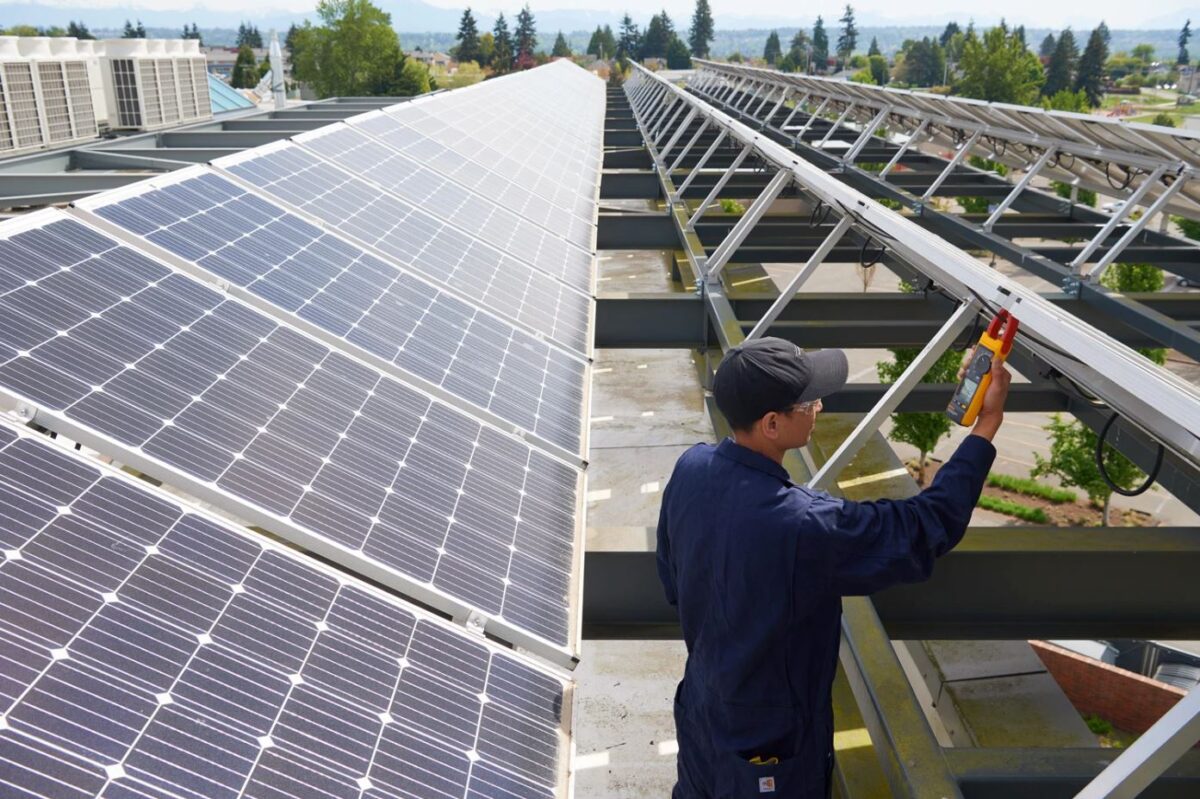
 The number of solar installations across the country is growing faster every year, creating an ever-increasing demand for technicians who know how to efficiently and effectively fix failures of photovoltaic (PV) systems.
PV system troubleshooting usually focuses on four parts of the system: the PV panels, load, inverter and combiner boxes.
The Fluke 393 FC CAT III 1500 V solar clamp meter is the best instrument to use in most areas of a solar installation. This is the world's only CAT III 1500V rated, IP 54 AC/DCa current clamp with features - such as DC voltage, audio polarity and visual continuity - tailored for testing and measuring in solar PV applications.
1. Troubleshooting the PV system
First check the output of the entire system at the metering system or inverter. Before you start troubleshooting, check and note the input voltage and current level of the array's inverter. You are likely to encounter one of two scenarios:
All or part of the PV system is down or not producing power; this may be related to a problem with the inverter.
Or the output of the PV system is less than expected; this may be related to a problem with one of the arrays or modules.
Trace individual branch wiring backwards from the concentrator. Visually inspect the entire system for obvious damage or inadvertent disconnection. Once you find the faulty module or array, check all wires, switches, fuses and circuit breakers. Replace blown fuses; reset circuit breakers and switches. Check for broken wires and loose or dirty connections; replace and clean if necessary. Watch for loose connections between modules. They may have come loose and caused lack of contact.
The combiner box can be a great place to troubleshoot system problems, as it returns individual wires from the modules to the system. Each module may have a fuse that you need to check with your Fluke 393 FC.
Wiring problems and loose connections can also cause a module to produce too low a voltage. Check all wiring connections. If a module output is low, it could mean that a single cell section is bad. These can be retraced using the 393 FC at the junction boxes until the culprit is found.
The Fluke 393 FC gives an audio polarity warning when you test Voc. If you notice that the polarity is reversed, this could mean that other circuits in the combiner box are inadvertently connected in series, resulting in voltages above the inverter's maximum input voltage.
Dirt or shadow on the modules themselves can cause reduced output. Although the modules are usually designed to be maintenance-free for years, they may need cleaning. Pollen and dust can be a significant problem in some parts of the country.
2. Solving problems with PV loads
The PV system is used to control building electrical loads; any problems with the loads also affect the system. The first step is to check the load switches, fuses and circuit breakers with the Fluke 393 FC to see if the load connection has the correct voltage. Next, use the 393 FC to check the fuses and circuit breakers. If you find blown fuses or tripped circuit breakers, find the cause and fix or replace the faulty component. If the load is a motor, an internal thermal breaker may be tripped or there may be an open winding in the motor. For testing purposes, connect another load and see if it works properly.
As with any electrical system, check for broken wires and loose connections. Clean all dirty connections and replace all bad wiring. If the power is off, then check for earth faults and repair them. If fuses or breakers blow or trip again, there is a short circuit that you need to locate and repair.
If the load still fails, use the Fluke 393 FC to check the system voltage at the load connection. The wire size may be too small and need to be increased. The wires running to the loads may also be too long. This is shown as a low voltage at the load. In this case, reduce the load on the circuit or run a larger wire.
 3. Troubleshooting PV inverters
You probably work with inverters every day, so you are used to checking AC and DC power. The inverter in a PV system can also fail and cause problems. The inverter converts direct current from the PV system into AC mains power for use in buildings.
If the inverter does not produce the correct output, first check and note the working DC input voltage and current level of the inverter. On the AC side, use the Fluke 393 FC to check the inverter's output voltage and current level. Many have a display that shows the performance of the current inverter and the system. Because the 393 FC produces a true-RMS reading, you can use the voltage and current to measure and record the kilowatt (kW) output. If possible, use the inverter display to show the current total kilowatt hours (kWh). You can then write down this value and compare it with the value recorded during the last inspection. On the DC side, you can use the 393 FC to check the DC power supply and store the value in the Fluke Connect™ app on your phone.
If the inverter is not producing the right amount of current, there could be several problems - all of which you can easily check with the Fluke 393 FC:
- Blown fuse
- Activated circuit breaker
- Broken wires
Use the Fluke 393 FC to measure the AC output side of the inverter; the load of the inverter may have an excessive current demand. With the dual display showing AC voltage and frequency, you can determine whether the inverter's AC output is working correctly.
The inverter can be connected to the local utility. The inverter's AC current fluctuates with the level of solar input on the array. The inverter maintains the correct output voltage and phase to the utility. Utility voltage problems may cause the inverter to shut down. In this case, contact the utility company for repairs.
4. Troubleshooting in combination boxes
When troubleshooting combiner boxes, current strength measurements and calculations are crucial to determine whether the PV arrays are working correctly. Measuring current on individual arrays or combining current measurements helps you determine if a cell is not working properly.
The thinner jaw design of the Fluke 393 FC current clamp allows you to get several conductors into the jaw for combined current measurements, even in tight or crowded spaces such as inverters or combiner boxes.