
 What does measurement have to do with energy saving? It's all about efficiency and the end result.
Industrial facilities need to consume energy to stay in operation, produce or generate data, whatever it is, and most facilities waste too much electricity in the process. They are inefficient users of energy. Twenty years ago, facility managers did not worry about energy efficiency - energy was cheap. As energy became more expensive, managers became increasingly interested in reducing their energy bills, but the measures had to be translated into business terms.
Where is the tipping point where waste is so great that it makes sense to address it?
To answer this question, you need to measure how much energy you consume for the different types of labour (systems) in your building and compare it with the standards. This will give you a good overview of how much wastage is taking place. By taking multiple measurements, you can determine what the root cause of the wastage is. The three points of an efficiency comparison are: 1) the amount of wastage combined with 2) the cause and 3) the cost to address it.
When does saving energy make sense?
Energy conservation makes sense for facilities that want to reduce overheads to increase productivity - facilities that want to do more with less, not just spend less.
Inspection of energy use helps identify opportunities to increase efficiency and gives the facility manager the tools to understand which energy-saving activities make sense, given the facility's primary objectives, and which energy savings do not yield enough return or are too far out of priorities. The greatest opportunities are usually found in facilities with old, large, energy-consuming systems that have not been optimised. Other good candidates are production facilities where not much automation or controls have been implemented, as well as facilities with large steam or compressed air systems.
How much can be saved?
According to the US Department of Commerce (DOE), facilities can reduce their energy bills by up to 25%, but how much can actually be saved depends on a number of things. First, it is necessary to look at what systems are in place and what activities take place in the facility. In particular, large loads that have never been mapped to the utility's tariff schedule, in order to take advantage of the cheapest dayparts, may well yield significant savings. A facility that processes mainly small taxes may not be able to benefit from this option. Secondly, it is necessary to assess how inefficient the building's systems are. A newer, well-maintained facility will not offer as many savings opportunities as an older facility, where systems and equipment no longer meet recommended settings and maintenance procedures.
When you think of energy waste at home, you probably think of draughts penetrating through gaps or old light bulbs being replaced by LEDs. But what kind of “energy waste” occurs in a mixed-use factory or facility?
Using energy to heat or cool air and forcing the ventilation system, which then leaks out of the window, forces the system to overproduce and thus overconsume. How many other systems in the facility work harder than they should because of clogged filters, oversized motors and so on?
So yes, waste can certainly occur in a factory or mixed-use facility, both in terms of lighting and the building envelope. But are these the first types of waste to be addressed?
You can only answer that question if you record energy consumption at all major loads, link it to both the tariff schedule and the operating schedule, and calculate efficiency. Often, so much can be saved in a facility on maintenance and operating processes for major equipment that enough money is saved within a few years to accelerate the replacement of this equipment with a less wasteful model.
Reducing energy consumption when budgets, time and resources are limited
Work from a baseline.
The starting point is to identify where and when energy is used and by what. Once the facility's owners, managers and technicians know exactly how much energy is needed to run the business, relative to the amount of energy being wasted, they can make decisions and determine a strategy. To achieve this status, it is advisable to check the latest utility bills and look for any penalties and charges related to demand during peak hours. Download a copy of the tariff schedule from the utility's website so that you know what energy units cost at different times of the day, compared to your operating schedule. If necessary, contact the utility company directly; they will be happy to help you.
Then instruct your own electricity team or an electrical engineer to log power at main utility entrances and at feeders to the largest systems and loads. Record kW, kWh and power factor over a representative time period. This gives you a very accurate picture of actual energy consumption at three-phase circuits and loads. The biggest savings are often made by shifting load processes to dayparts with cheaper energy costs.
Which systems cause the biggest energy waste?
Assess not only the electrical supply system, but also look at your electromechanical, steam and compressed air systems. These systems are usually full of energy waste, which is nevertheless easy to solve.
Electromechanical
There are five common types of energy waste in an electromechanical system: 1) electrical, 2) mechanical/friction, 3) scheduling, 4) control and 5) sizing/efficiency.

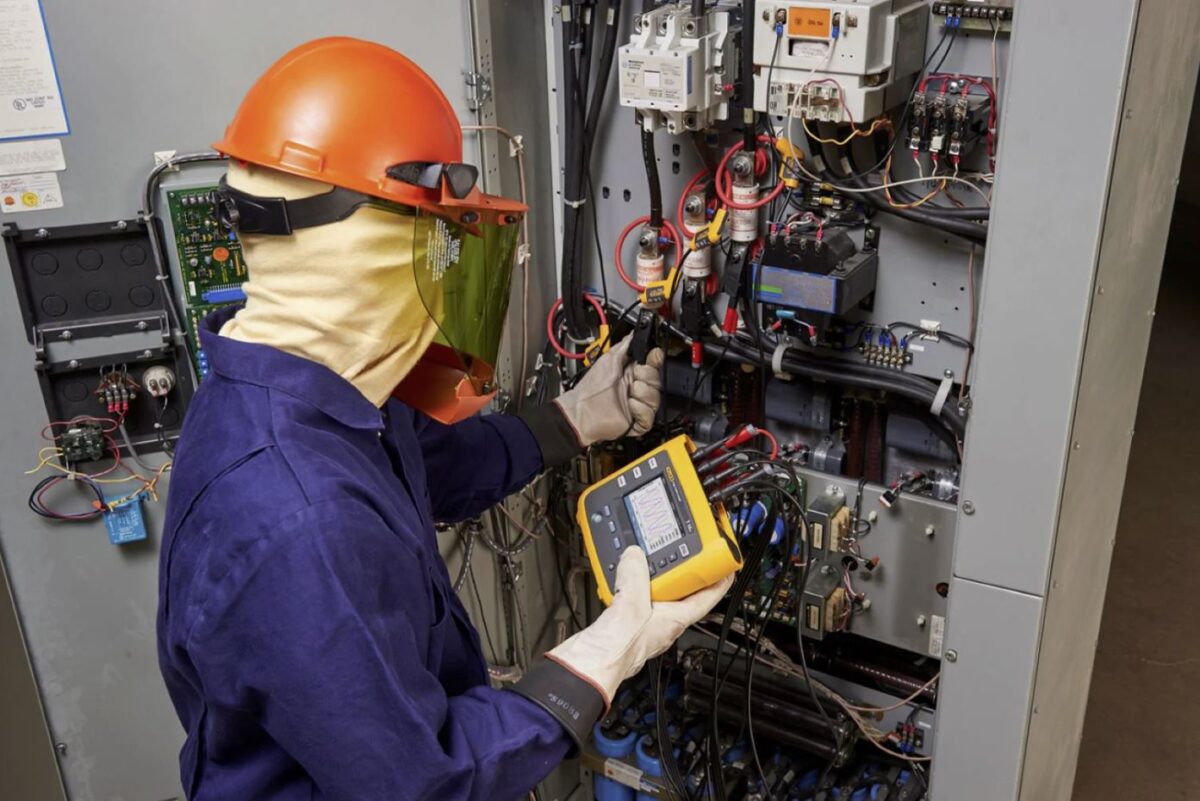
A Fluke 1738 use advanced Power Energy Logger to investigate the energy consumption of a mechanical system
- Voltage/current overload and unbalanced phasing are two of the most common energy wasters in electromechanical systems. Both electrical problems can be detected with Power Quality Analyzers and thermal imaging cameras.
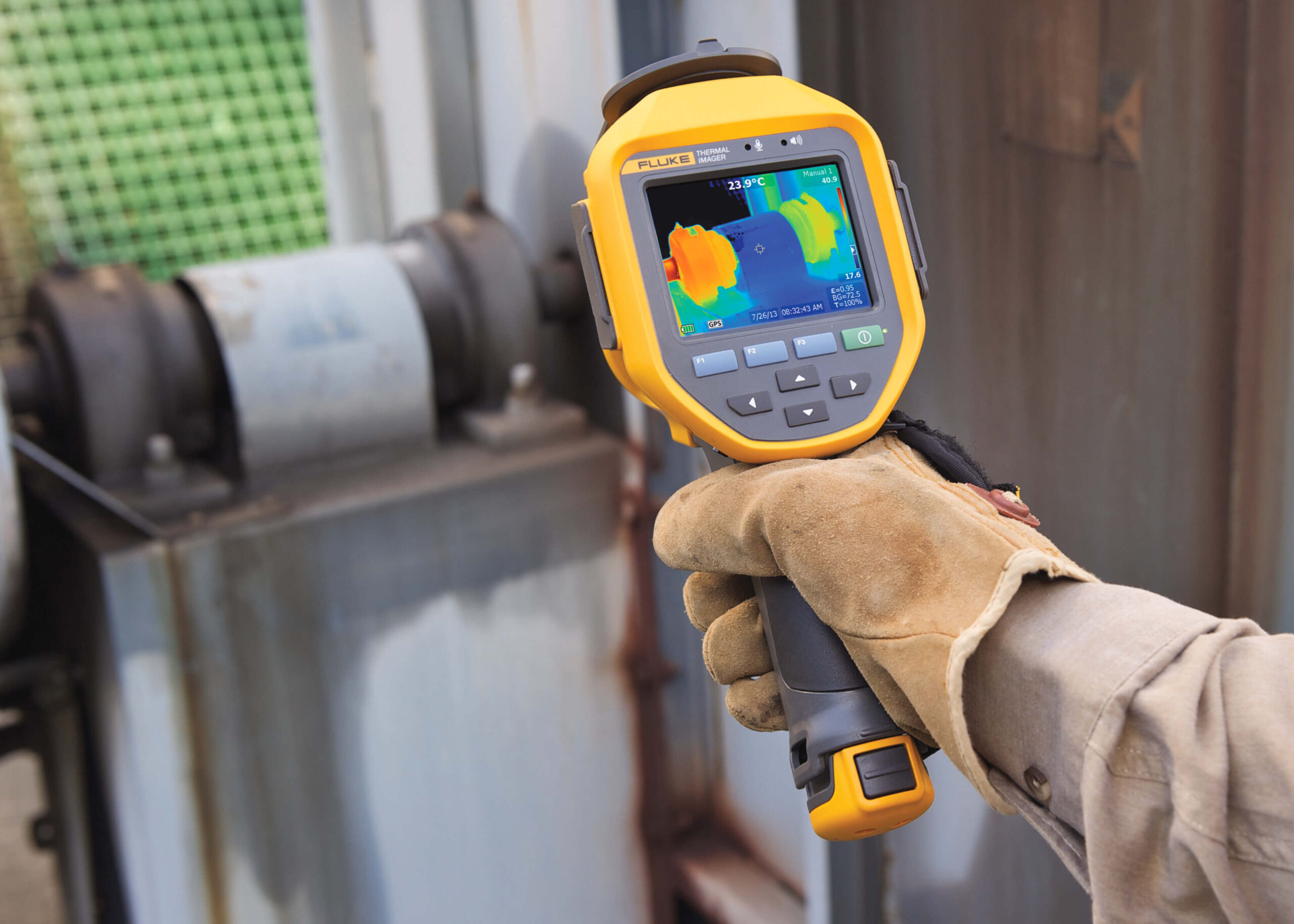
- Energy waste in mechanical systems manifests itself as overheating, as well as excessive vibrations. These can be detected with thermal imaging and vibration meters. Possible causes range from cooling and airflow to bearing alignment and other causes of friction. So perform a thermal scan on couplings, shafts, belts, bearings, fans, electrical components, termination/connection box and windings - all options that may be operating inefficiently and thus wasting energy.
- As mentioned earlier, one of the simplest solutions for saving energy is to log energy consumption at large electromechanical loads during a full operating schedule. Determine when equipment consumes the most energy (often at start-up) and check whether usage times can be shifted to dayparts when consumption rates are cheapest.
- Using the same consumption log, compare the operating schedule with the frequency at which the appliance consumes energy. How much energy does the appliance consume when not in operation? Without automatic switches, most appliances have to be switched off manually to stop energy consumption, and manual operations are often not performed. Not all appliances can be switched off, but most appliances can be put on standby. Operation can vary, from simple to fully automated; and from operation using sensors and timers to flexibly inactive machines and capturing business processes in a PLC.
- Scaling and efficiency levels. Especially in older facilities, it is common for business processes to change but loads to remain unchanged. This means that a large, expensive, start-up motor sometimes drives a system that does not need that much power at all. Branch managers are naturally inclined to use large equipment for as long as possible. However, it is worth looking at how much power the motor uses, compared to the actual load requirements and compared to a new, highly efficient unit of the right size. Calculate how much excess power is consumed and multiply that value by the rate payable. Also determine how long it will take for a new motor to pay for itself: sometimes it makes sense to replace equipment before it breaks down. If not, consider whether you can set the controls to regulate output.
Steam
Process heating accounts for a significant proportion of controllable operating costs and the system should be inspected regularly to avoid various energy waste scenarios.
To start with, record energy consumption at the boiler to establish a baseline for energy consumption. Next, inspect the distribution system, including steam traps, manometers, insulation, pumps and valves. Use a thermal imaging camera to detect faulty steam traps, leaks, blockages, value problems and condensate failures: the aim is to return as much pre-heated condensate as possible to the boiler.

You can also use a thermal imaging camera to check for steam leaks. Check for loose or missing insulation and the proper functioning of all steam traps; clean the inside of boilers and check steam transport pipes for blockages. By performing all these actions, you can detect energy waste and help your team plan energy-saving solutions. Many of these can often already be implemented through maintenance, rather than capital expenditure.
Compressed air
A 100-hp air compressor can consume about $50,000 in electricity annually, and 30% of that electricity goes to pressurising air that is never used due to distribution leaks and waste during operation. However, many facilities have never assessed the efficiency of their compressed air processes. When more air pressure is needed, many facilities will purchase and deploy an additional compressor, not realising that they can get more pressure from their existing system.
Compressed Air Challenge studies show that only 17% of compressed air users see efficiency as the goal of compressed air system management, but 71% simply want a consistent, reliable air supply. That philosophy manifests itself during operation: facilities with pneumatic equipment often lack even simple solenoid valves, which drive the compressor continuously. Staff on the shop floor often see compressed air as a free resource, using it to clean the work area and even to cool down.
To identify and quantify the level of waste, you can start by logging energy consumption over a full duty cycle across all air compressors. This will give you an insight into how much energy is needed to produce current air pressure levels. Also, using a pressure calibrator record the psi at the compressor output and compare it with the point of use. This allows you to determine the pressure drop and check that the psi required by the manufacturer for pneumatic equipment use is achieved; do not “just use” too much pressure. By connecting a pressure module to a logging multimeter to perform these tests, you don't need to invest in specialised equipment right away. Finally, you can still use a sonic Industrial Imager to scan as much of the air pipe surface as possible to determine the location and extent of air leaks. Find out how great the returns are with these air leakage calculator.
Conclusion
Ultimately, you can make great strides to improve energy efficiency at plant level with these simple and logical best practices. Individually, they already add value, but in combination they can be a treasure trove of energy savings.