
 Fluctuating commodity prices make it challenging for companies to adjust to the times and maintain good profit margins. One way to control costs across industries is to become leaner and more efficient.
And one of the best ways to control these costs is to find the waste in your process. With regard to instrumentation, this means making many precise adjustments to achieve just the right the temperature and pressure for high-quality production and efficient use of resources.
Equipment calibration leads to better optimisation and higher quality. This also applies to other sectors of the process industry, be it the chemical process industry, nuclear industry, pharmaceutical industry or pulp and paper industry. Manufacturing plants for the process industry use hundreds or even thousands of sophisticated devices that constantly perform countless critical operations in an accurate and reliable manner. These devices themselves also need regular inspection, testing, calibration and repair.
Over the centuries, the importance of carefully recording the details of these inspections, tests, calibrations and repairs has become clear. It is not just a best practice; companies and governments often have highly specific administrative requirements to ensure that customers receive products of the highest quality and the health and safety of citizens are protected.
However, traditional testing, calibration and documentation processes are labour-intensive; because experienced users are scarce, downsized teams sometimes choose to postpone regular calibrations. The latest industry findings suggest that it is feasible for smaller teams to perform and document equipment calibrations at a lower overall cost, with greater productivity and operational reliability benefits.
Calibration of equipment is usually performed at the site of the device (in-situ calibration, from Latin for ‘in place’) or in an instrument workshop.
Professional tip:
During production of a field instrument, both the primary element and the transmitter (or actuator, if a control valve) are calibrated at the factory and calibration information is supplied with the unit. This calibration data is often lost. Entering this information into centralised calibration data as soon as the unit is put into service should be part of standard work and not just done to increase efficiency.
By centralising calibration information, the knowledge stays with the facility even if the teams change.
Most field instruments consist of two parts: a primary element and a transmitter.
- Primary elements include flow tubes, measuring flanges, pressure sensors, wet chemical sensors such as pH, ORP and conductivity probes, level gauges of all types and temperature sensors. Primary elements usually produce a signal - usually voltage, current or resistance - proportional to the variable they measure, such as level, flow, temperature, pressure or chemical composition. Primary elements are connected to the input of field transmitters.
- Field transmitters include pressure, temperature and flow devices. They process the signal generated by the primary element by first characterising it in linear form and applying unit of measurement coefficients to it. The signal is then transmitted in analogue (usually 4-20 mA DC) or digital form (usually a variety of fieldbuses).
 Analogue devices
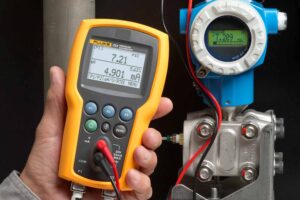
Analogue devices, often called ‘4 to 20 mA loop devices’, are so called because they transmit a signal that is an electrical “analogue” representation of a measured physical quantity (e.g. temperature). They transmit an electric current that is proportional (analogue) to the magnitude of a measured physical quantity, with 4 mA representing the minimum scaled value and 20 mA the maximum scaled value.
Although many aspects of systems are now digital, analogue devices are still used in the process industry.
Digital devices
Digital devices convert a measured physical value into a digital signal. Many different digital coding methods are used in the process industry, including Foundation Fieldbus, Profibus and HART.
It is widely believed that (digital) fieldbus devices do not need to be calibrated. However, this is not true. Although a fieldbus signal (whether Foundation Fieldbus, Profibus or connected HART) provides diagnostic information, it does not provide any information about the accuracy of the device, nor does it check whether the device provides an accurate representation of the process.
Top 3 calibration tools to keep your processes lean
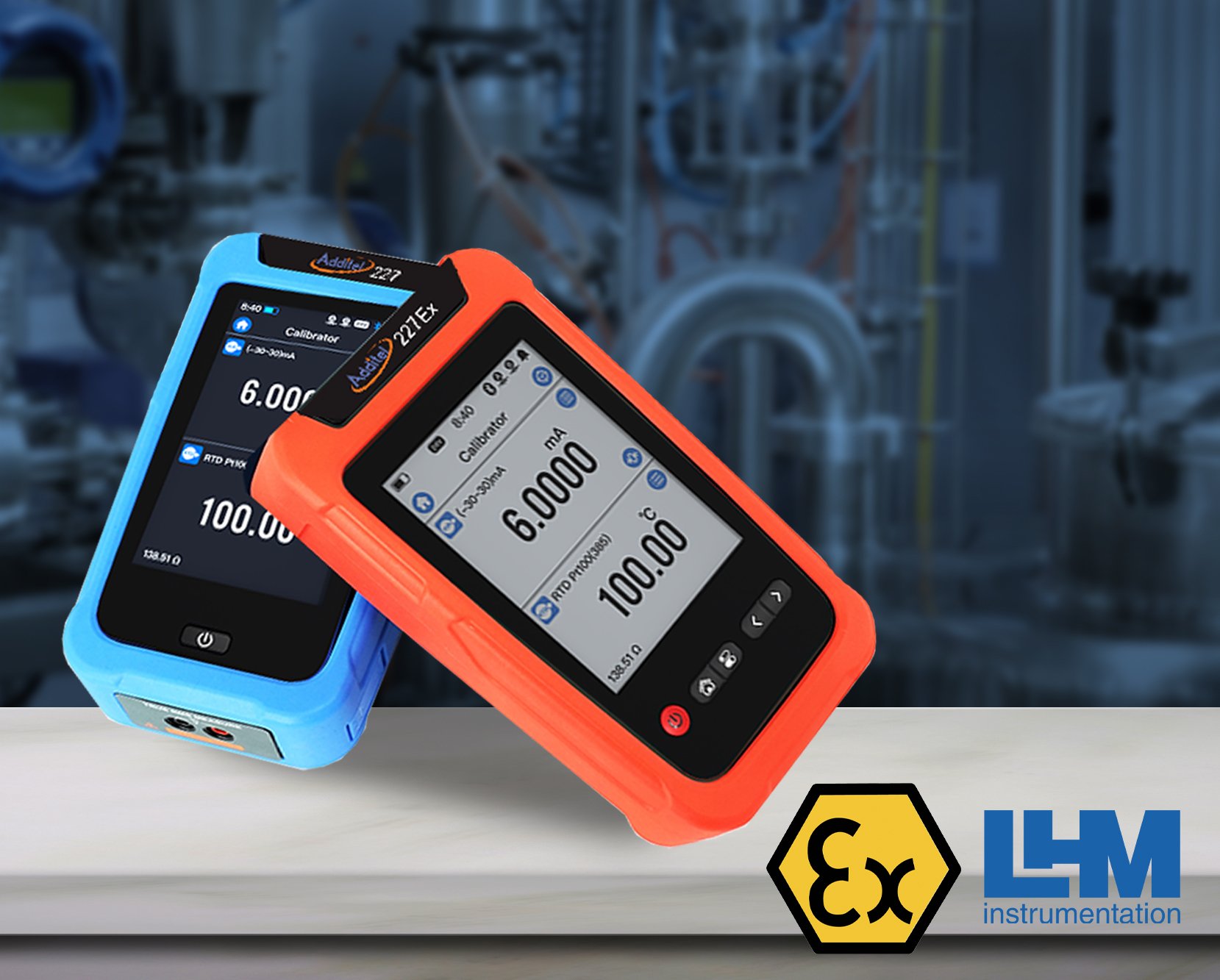
1. Additel ADT227 multifunction documenting calibrator with HART functionality and automated calibration procedures; the ADT227 is also available in ATEX version.
2. Additel ADT760 Automatic precision pressure calibrator with documenting function and HART functionality
3. Fluke 754 multifunctional documenting calibrator with HART functionality and automated calibration procedures; the calibrator naturally complies with strict safety standards.
 Control valves
Control valves have actuators that also need to be calibrated to compensate for wear and tear and the effects of valve sticking and when the valve has been resealed to correct leaks. Often, when these valves are not operated regularly, a stroke test or partial stroke test must be performed for them to ensure reliable operation.
Permits and paperwork
Administrative tasks, from applying for permits to documenting and archiving results, can add significantly to the cost and time required for even an in situ calibration. As Ian Vergebeuren of Industrial Automation Networks and a former chair of the Fieldbus Foundation User Group says, “In many cases, getting all the necessary paperwork (permits, isolation, etc.) takes longer than the work itself.”
Challenges in documenting calibrations
Documenting a calibration has traditionally meant manually recording the date and time, pre- and post-calibration values and other comments made by mechanics in a logbook. Surprisingly, many companies continue to document calibration data manually. But handwritten documentation is far from ideal.
Firstly, the likelihood of errors is higher. Handwritten data is often illegible or incomplete. Facilities using a computerised maintenance management system (CMMS) then have to take into account the extra time required to enter handwritten data, which adds another risk of errors.
Changes within workforce
Another challenge for calibration is a change in the workforce.
The 1980s saw budget cuts and layoffs. Countless engineers, maintenance workers and operational staff were laid off following a new lean manufacturing philosophy that is still followed today, especially in developed economies.
Smaller teams have less time for on-the-job mentoring and training, to the point where employees have no time to transfer their equipment- and system-specific knowledge. Once older operators and engineers retire, they take their equipment and systems knowledge with them.
“Every day at 16:00, virtually all plant knowledge walks out the door, and sometimes for good,” says the Chief Instrumentation and Controls Engineer at a large refinery in the Midwest.
Meanwhile, many companies still need two technicians for each in-situ calibration: one at the transmitter and one at the control system. The Fieldbus Foundation estimates that two technicians require a minimum of two hours for commissioning.
 Use multifunction documenting calibrators
A new generation of ‘smarter’ field calibrators increases employee productivity by combining multiple instruments into one and offering features that go beyond basic testing and measurement, including help with analysis and documentation.
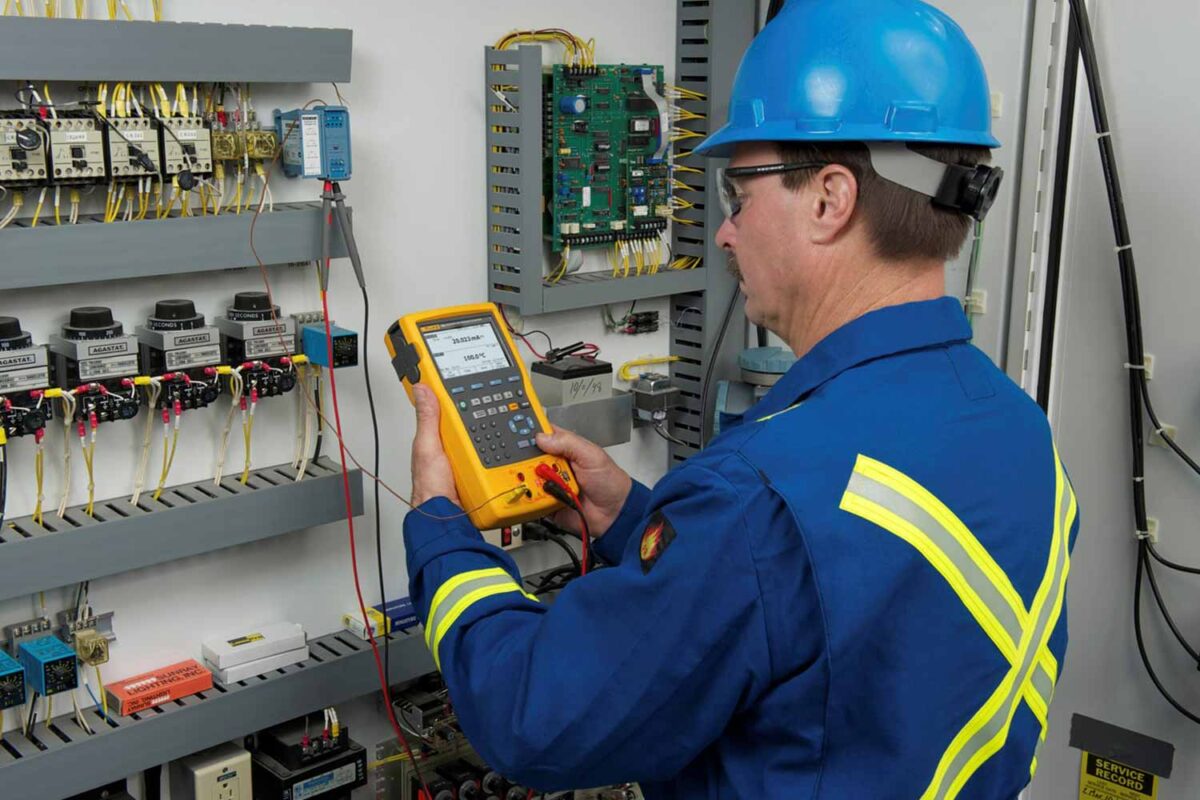
Multifunctional documenting process calibrators are portable, electronic test and measurement instruments that combine multiple calibration steps and functions in one device, simulating and measuring pressure, temperature and a wide range of electrical and electronic signals.
Advantages:
- Technicians need to master fewer instruments and take them into the field
- Same calibration processes and data output on multiple devices instead of having to follow a different process for each instrument to collect a different set of data
- Automated procedures replace many manual calibration steps
- No second technician is needed to record the ‘as found’ and ‘as left’ status of the field instrument.
- Faster calibration time per device
- Calculate the error of one instrument instead of adding up the errors of different instruments
Use calibration routes
With a documenting calibrator, the greatest savings can be achieved by using the route management function integrated into the instrument. Using one set of permits and paperwork for a full set of calibrations significantly reduces costs.
Implement an asset management, calibration management or computerised maintenance management system (CMMS)
Unlike paper documentation, data on the calibrator are never illegible, inaccurate or incomplete. Calibrator data can be downloaded directly to various CMMS systems without transcription or archiving.
Documenting process calibrators automatically capture on-site ‘as-found’ and ‘as-left’ status of each field device and can be operated by a single technician. As a result, using route-based procedures on documenting calibrators can reduce the time and cost required by as much as 50% compared to traditional manual single-device calibration methods. In other words, the same lean team can perform twice as many calibrations in the same period of time.
Running a lean team according to traditional operational requirements undoubtedly leads to mistakes. Calibrations are simply not carried out as they should be. Instead of ignoring the threat, explore how existing activities can be run more efficiently.
Implement route-based calibration, paperless documentation and CMMS data management. More calibrations are performed more accurately, knowledge is transferred from one person to the team and the company, and both productivity and quality increase.
Calibrating multiple instruments during a route reduces the cost per calibration compared to calibrating individual instruments separately.
In addition, millions can be saved on maintenance costs, legal fees and the cost of lost revenue due to accidents. Good calibration procedures help reduce the likelihood of such incidents. In the event of an emergency or legal action, companies can defend themselves with accurate calibration data, whereas this is a lot more difficult when calibration data is not in order.