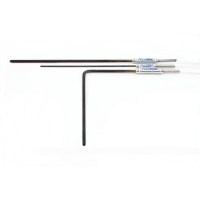

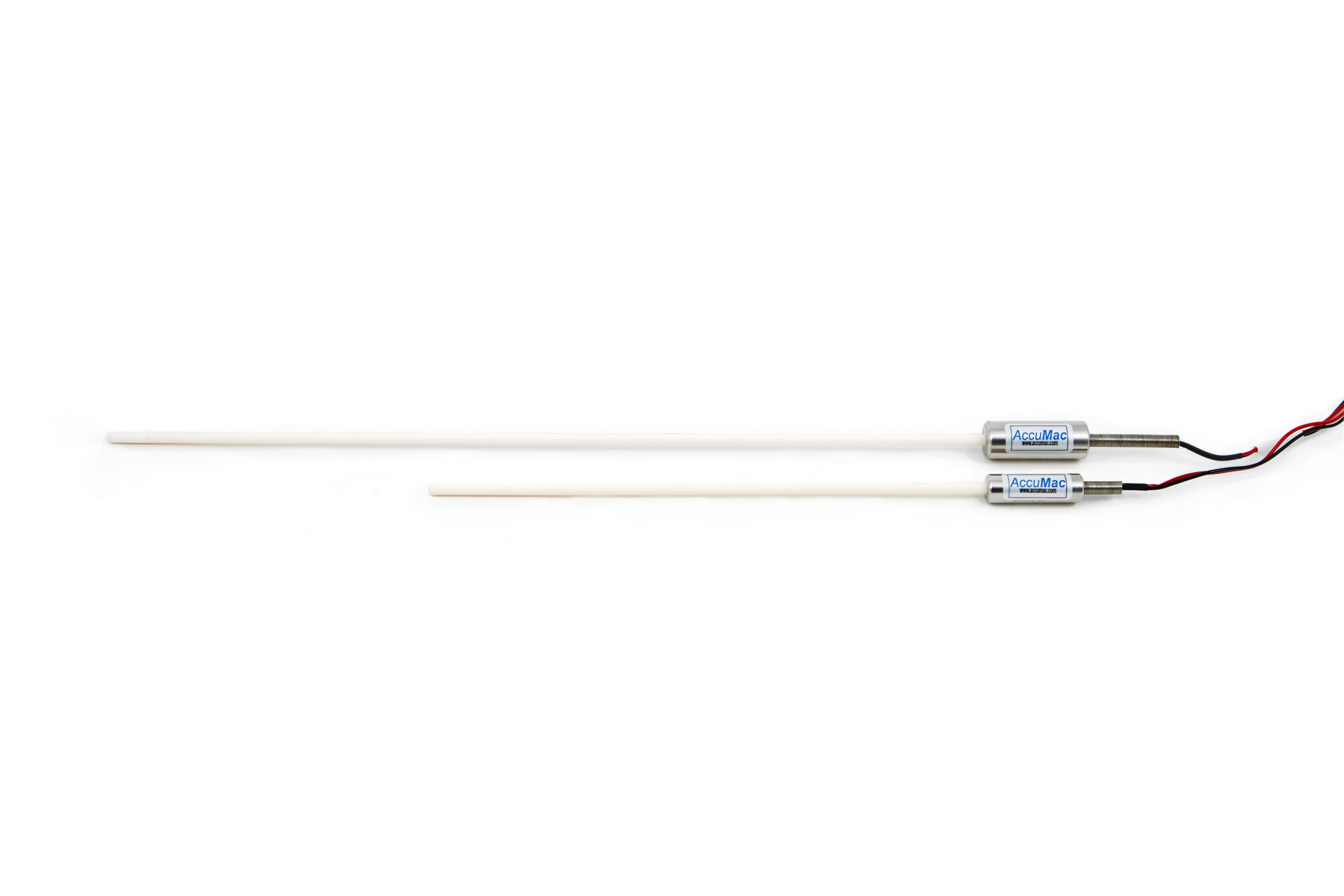
The AM1210 reference standard type S thermocouple is made of reference grade platinum and platinum-rhodium alloy. It has a temperature range of 0°C to 1300°C with a short-term stability of <0.2°C to the freezing point of copper (1084.62°C). It is widely used as a reference standard to calibrate industrial thermocouples.
All thermocouple wires and components are specially cleaned and annealed before assembly. Each AM1210 thermocouple is fully annealed and tested again after assembly to meet the tolerance criteria as specified below:
E(tCu)=10.575 ±0.015
E(tAl)=5.860+0.37(E(tCu)-10.575) ±0.005
E(tZn)=3.447+0.18(E(tCu)-10.575) ±0.005
What is a Reference Type S thermocouple?
A reference type S thermocouple is a specific type of temperature sensor, known for its high level of accuracy and stability. These thermocouples are used in applications where very precise temperature measurements are required, such as in laboratories, in calibration processes and in industrial environments where high reliability is essential.
The type S thermocouple consists of two different metals: platinum and a platinum-rhodium alloy. These materials are used to form a pair of wires, with one wire being pure platinum and the other containing a platinum-rhodium alloy. When the weld (the point where the two wires meet) is exposed to a temperature, a thermoelectric voltage is generated that depends on the temperature. This voltage is measured and converted into a temperature value.
One of the key features of the Type S thermocouple is its reliability and accuracy over a wide temperature range, typically from about -50°C to 1768°C. This makes it particularly suitable for applications where very high temperatures need to be measured, such as in metal processing or ceramic industries.
These thermocouples are also known for their long life and resistance to oxidation, making them ideal for use in harsh industrial environments. They are often used as standard references in calibration laboratories because of their stable output and reproducibility.
Although type S thermocouples are more expensive than other types of thermocouples, this extra cost is justified by their superiority in terms of accuracy, stability, and lifetime, especially in critical and precise temperature measurement environments.